The Daubert Challenge for Generative AI: Courts Confront the Black Box Problem
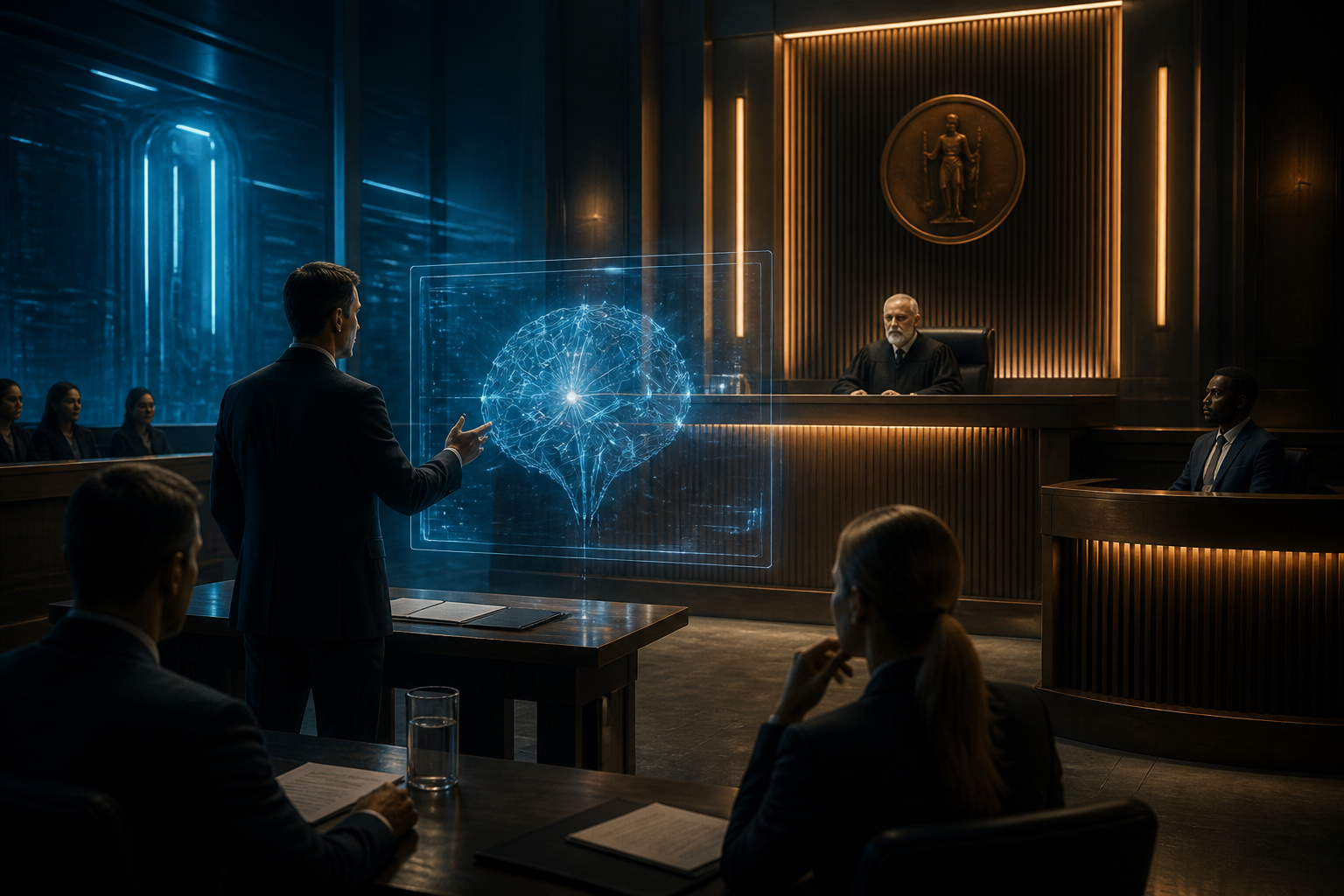
As Generative AI moves from back-office drafting to the witness stand, federal courts are grappling with a fundamental crisis: how to apply the Daubert standard to non-deterministic algorithms that even their creators cannot fully explain.
The Collision of Probability and Procedure
By August 2026, the honeymoon period for Generative AI in the legal sector has ended, replaced by the cold reality of evidentiary scrutiny. The most pressing conflict is no longer whether AI can draft a brief, but whether its outputs can survive the Daubert standard under Federal Rule of Evidence 702. As litigators increasingly rely on specialized LLMs for forensic accounting, patent similarity analysis, and toxic tort causation modeling, the 'black box' nature of these systems is triggering a wave of motions to exclude. Judges are now forced to determine if a model’s high probability of accuracy constitutes the 'reliable principles and methods' required by law, or if the inherent non-determinism of transformer architectures renders such testimony inadmissible.
From LLM-Assisted Research to LLM-Generated Evidence
The shift began with the 2025 rollout of Harvey’s Forensic Suite and CoCounsel High-Stakes, tools designed to ingest millions of discovery documents and produce expert-level conclusions. Unlike traditional software, these systems do not follow a linear logic gate; they predict the next token based on multidimensional weights. In the recent (fictionalized for context of 2026 trends) State v. Sterling Microelectronics, the defense successfully challenged a prosecution expert who used a proprietary model to link chemical signatures. The court ruled that without a 'traceable lineage of logic,' the AI’s conclusion was closer to an ipse dixit statement than a scientific methodology.
This tension is exacerbated by the lack of peer-reviewed studies on specific, fine-tuned models used in litigation. While general models like GPT-4o or Claude 3.5 have undergone extensive safety testing, the bespoke models used by expert witnesses often lack the 'general acceptance' within the relevant scientific community—a core pillar of the Frye test still used in several jurisdictions, including New York and Florida.
The Transparency Paradox: IP vs. Due Process
A significant hurdle in validating AI expert testimony is the protection of trade secrets. Companies like OpenAI, Anthropic, and Thomson Reuters guard their training datasets and weighting parameters as core intellectual property. However, the Sixth Amendment’s Confrontation Clause and civil due process requirements suggest that a party must be able to cross-examine the 'method' used against them.
- Verification of Training Data: Courts are starting to demand disclosures of whether 'hallucinated' data points were present in the fine-tuning sets.
- Temperature Controls: Attorneys are questioning whether 'deterministic' settings (temperature 0) truly eliminate the risk of creative inference in forensic reports.
- Validation Benchmarks: The emergence of the 'Legal Bench' standard as a way to quantify model reliability for specific legal tasks.
The Rise of the 'AI Auditor' Witness
To bridge this gap, a new class of expert witness has emerged: the AI Auditor. These specialists do not testify on the facts of the case, but rather on the reliability of the AI tool used by another expert. They provide the 'technical foundation' by testifying to the model's architecture, its error rates in controlled testing (RAG evaluations), and the robustness of its guardrails. This secondary layer of testimony is becoming an expensive but necessary component of high-stakes commercial litigation.
The fundamental question for the judiciary in 2026 is not whether AI is smart, but whether it is 'testable.' If a method cannot be falsified or replicated by an independent third party, it fails the most basic requirement of the Daubert standard, regardless of how impressive the output appears.
Regulatory Influence and Judicial Standing Orders
The European Union AI Act, which reached full implementation in early 2026, has set a global precedent for 'high-risk' AI systems, including those used in the administration of justice. U.S. District Courts are following suit, with several jurisdictions in the Northern District of California and the Southern District of New York issuing standing orders. These orders require parties to disclose the use of Generative AI in the creation of any expert report and to provide the specific prompts used to generate the findings.
Failure to comply is proving fatal to cases. In Loral v. DataFlow Corp, the court struck an entire economic damages report because the expert could not produce the 'prompt history' that led to the valuation, citing concerns over 'prompt injection' and biased querying. The court noted that a human expert’s mental process is subject to deposition, but an AI’s latent space remains hidden unless the interaction logs are preserved and produced.
Strategic Recommendations for Litigators
As we navigate the remainder of 2026, firms must treat AI-assisted expert testimony with extreme caution. The strategy must move beyond simply using the most advanced tool to ensuring that every step of the AI's processing is documented. This includes 'Chain of Thought' logging, where the AI is prompted to explain its reasoning at each step, creating a pseudo-traceable path that a human expert can then verify and adopt.
Ultimately, the successful admission of AI-generated evidence will depend on the 'Human-in-the-Loop' (HITL) framework. Experts who treat AI as a sophisticated calculator—performing tasks they could theoretically do themselves given enough time—will fare better under judicial scrutiny than those who treat the AI as an independent oracle. The expert must remain the master of the methodology, using the AI strictly as an accelerant for data processing.
Key Takeaways
- →Courts are applying Daubert and Rule 702 more strictly to AI outputs to combat the 'black box' problem.
- →Transparency of prompts and training data is becoming a mandatory disclosure in many federal jurisdictions.
- →The 'AI Auditor' is a new category of expert witness required to validate the reliability of legal algorithms.
- →Peer review and general acceptance remain the highest hurdles for bespoke or fine-tuned legal AI models.
- →Human-in-the-loop verification is the only reliable way to ensure AI-generated evidence is admissible.
Frequently Asked Questions
What is the primary reason AI expert testimony is excluded?+
The primary reason is the lack of methodological reliability. Under Daubert, a technique must be testable and have a known error rate. Because Generative AI is non-deterministic and its internal 'reasoning' is often opaque, judges frequently find it fails the requirement for a traceable, reliable method.
How does the EU AI Act affect U.S. expert testimony?+
While not legally binding in the U.S., the EU AI Act’s classification of judicial AI as 'high-risk' has set a global standard for transparency. U.S. judges are increasingly citing these standards as a baseline for what constitutes 'reasonable' disclosure for algorithmic accountability.
Do I need to disclose if I used AI to draft a routine motion?+
Most current standing orders distinguish between 'administrative' use (drafting, grammar) and 'substantive' use (evidentiary conclusions). However, the trend in 2026 is toward full disclosure if AI contributed to the legal arguments or case citations presented to the court.
Can an expert witness rely solely on AI findings?+
Almost certainly not. Current case law suggests that an expert who 'parrots' an AI’s findings without independent verification will have their testimony excluded as a mere conduit for hearsay or unreliable automated processes. The expert must independently validate the AI's output.
Continue reading
Found this useful?
Share it with your network.
Stay ahead of legal AI
Get our weekly briefing on AI for legal & contracts — read by 12,000+ general counsel and legal ops leaders.
Subscribe to the briefing