The Judicial Counter-Strike: How Federal Courts Are Reclaiming Control from Black-Box AI
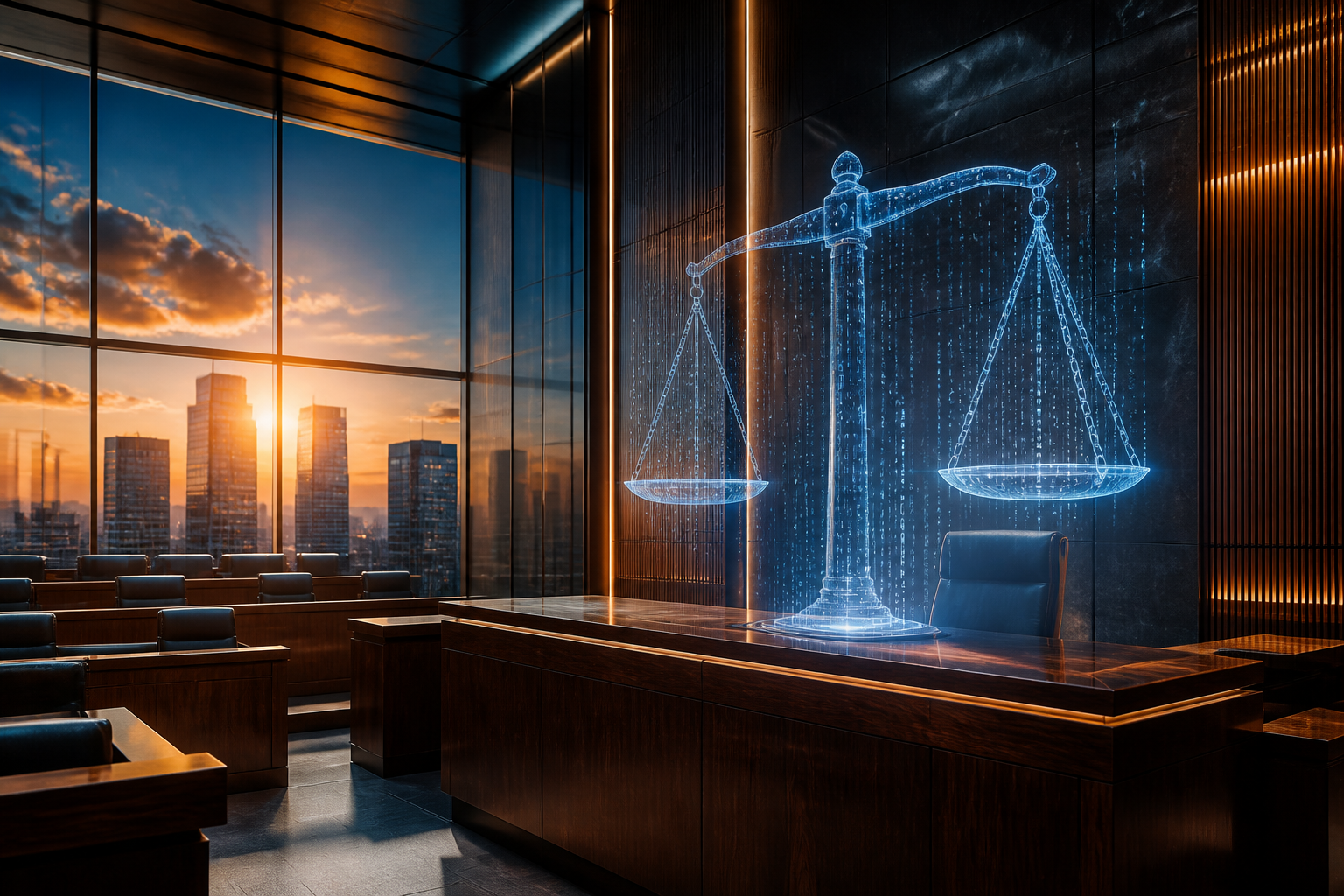
As autonomous legal drafting becomes the industry baseline, the judiciary is responding with a flurry of local rule amendments. We examine the 2026 enforcement landscape where 'AI hallucinations' are no longer viewed as errors, but as professional misconduct.
The Shift from Curiosity to Censure
For the past three years, the legal industry treated the integration of Large Language Models (LLMs) as a technological evolution. However, by mid-2026, the honeymoon period has ended. The U.S. District Court for the Southern District of New York and the Fifth Circuit Court of Appeals have moved beyond mere cautionary standing orders to active, punitive enforcement. The catalyst was the 2025 case United States v. Thorne, where a sophisticated AI-orchestrated defense strategy was found to have fabricated non-existent legislative history. Unlike the early, clumsy hallucinations of 2023, these fabrications were subtle, contextually plausible, and designed to bypass standard citation checkers. The result is a new judicial environment where the 'I didn't know the AI did that' defense is treated with the same severity as intentional fraud on the court.
The 2026 Verification Mandates: Beyond the Affidavit
The procedural landscape has been fundamentally altered by the widespread adoption of 'Mandatory AI Disclosure and Verification' (MADV) protocols. Currently, 42 federal districts require a signed certificate of human verification for every citation generated or refined by an automated system. Companies like Thomson Reuters and LexisNexis have integrated 'Judicial Audit Trails' into their flagship products, yet the burden of accuracy remains strictly on the human signatory. These tools now provide a cryptographic hash for every case law citation, intended to prove the text originated from a verified database rather than a generative model's predictive engine.
However, the sophistication of 'Deep-Reasoning' agents has introduced a new layer of risk: the algorithmic bias in case selection. Judges are increasingly skeptical not just of fake cases, but of the systematic omission of adverse authority. In June 2026, a Delaware Chancery Court judge sanctioned a top-tier firm for what was termed 'algorithmic cherry-picking,' where the firm’s proprietary AI model consistently filtered out precedents that weakened their client's position, claiming they were 'statistically irrelevant' to the prompt.
Sanctions and the New Rule 11
The interpretation of Federal Rule of Civil Procedure 11 has undergone its most significant transformation in decades. The 'reasonable inquiry' standard now explicitly includes a technical duty of competence regarding AI architecture. If an attorney uses a tool without understanding its temperature settings or grounding mechanisms, they are increasingly found to be in violation of their duty to the court. The financial penalties are escalating; recently, a boutique litigation firm in California was ordered to pay $150,000 in 'technological negligence' fines after their automated discovery tool inadvertently leaked privileged metadata that the AI had been instructed to redact but failed to recognize due to a formatting error.
The court will no longer distinguish between a lawyer who lies and a lawyer who delegates their integrity to an unverified algorithm. Both are equally corrosive to the adversarial process and will be met with the full weight of judicial sanctions.
Professional Liability Insurance in the AI Era
Carrier response to these sanctions has been swift. Major insurers such as ALAS and Berkshire Hathaway Specialty Insurance have introduced 'AI Exclusion Clauses' for firms that cannot demonstrate a robust internal AI Governance Policy (AIGP). These policies are no longer optional documents; they are scrutinized during renewals as rigorously as financial audits. Firms must now prove they have human-in-the-loop (HITL) checkpoints for every phase of the litigation lifecycle, from initial intake to final briefing.
The Rise of Judicial AI-Detection Tools
It is not just the lawyers who are arming themselves. The Administrative Office of the U.S. Courts has begun piloting 'Argus,' a judicial oversight AI designed to scan incoming filings for synthetic patterns and citation anomalies. Argus serves as an early-warning system for clerks, flagging briefs that show high probability of non-human linguistic structuring or 'logic jumps' common in automated drafting. This has led to a technological arms race, with law firm IT departments attempting to 'humanize' AI output to avoid the Argus flag, while the court continues to tighten the detection parameters.
- Implementation of multi-vector citation verification (cross-referencing three independent databases).
- Mandatory disclosure of 'prompt engineering' logs during discovery disputes.
- Increased scrutiny on AI-generated expert witness testimony and underlying data sets.
- Judicial demands for 'explainability' in automated risk assessment models used in sentencing.
Navigating the Post-Automation Courtroom
As we look toward the final quarter of 2026, the message from the bench is clear: efficiency will never be prioritized over accuracy. The firms that are thriving are not those that have replaced their associates with agents, but those that have doubled down on legal research fundamentals, using AI as a high-speed library assistant rather than a substitute for legal thought. The 'black-box' excuse has been permanently retired. The future of legal practice belongs to the 'Verified Practitioner'—those who can bridge the gap between lightning-fast computation and the immutable requirements of the rule of law.
Key Takeaways
- →Federal courts have shifted from advisory warnings to aggressive Rule 11 sanctions for AI errors.
- →Cryptographic verification of case citations is becoming a standard requirement for federal filings.
- →Professional liability insurance now frequently requires documented AI Governance Policies (AIGP).
- →Judicial AI detection tools like 'Argus' are being deployed to screen filings for synthetic content.
- →Failure to understand AI tool parameters is now legally recognized as a breach of technical competence.
Frequently Asked Questions
Can I be sanctioned if the AI generates a fake case that I didn't catch?+
Yes. Under 2026 judicial standards, the attorney of record is strictly liable for all content in a signed filing. Courts now view 'AI hallucinations' as a failure of the attorney's duty to conduct a reasonable inquiry under Rule 11, regardless of whether the error was intentional or a technological glitch.
What is a 'Judicial Audit Trail' in legal software?+
A Judicial Audit Trail is a metadata log provided by premium legal research platforms that proves a citation was sourced from a verified, human-edited database. It often includes a timestamped, cryptographic proof of the citation's origin to distinguish it from generative AI fabrications.
Are law firms required to disclose their use of AI to clients?+
Most state bar associations, following ABA Model Rules updated in 2025, require disclosure if the AI usage significantly impacts the cost, strategy, or data privacy of the representation. Many firms now include an 'AI Consent' clause in their standard engagement letters.
How do judicial detection tools like 'Argus' work?+
These tools use pattern recognition to identify linguistic markers typical of LLMs, such as specific syntactic structures and a lack of varied sentence complexity. They also cross-reference all citations against a real-time database of valid legal authorities to flag potential fabrications instantly.
Continue reading
Found this useful?
Share it with your network.
Stay ahead of legal AI
Get our weekly briefing on AI for legal & contracts — read by 12,000+ general counsel and legal ops leaders.
Subscribe to the briefing