Beyond Predictive Coding: The Rise of Autonomous AI Agents in Electronic Discovery
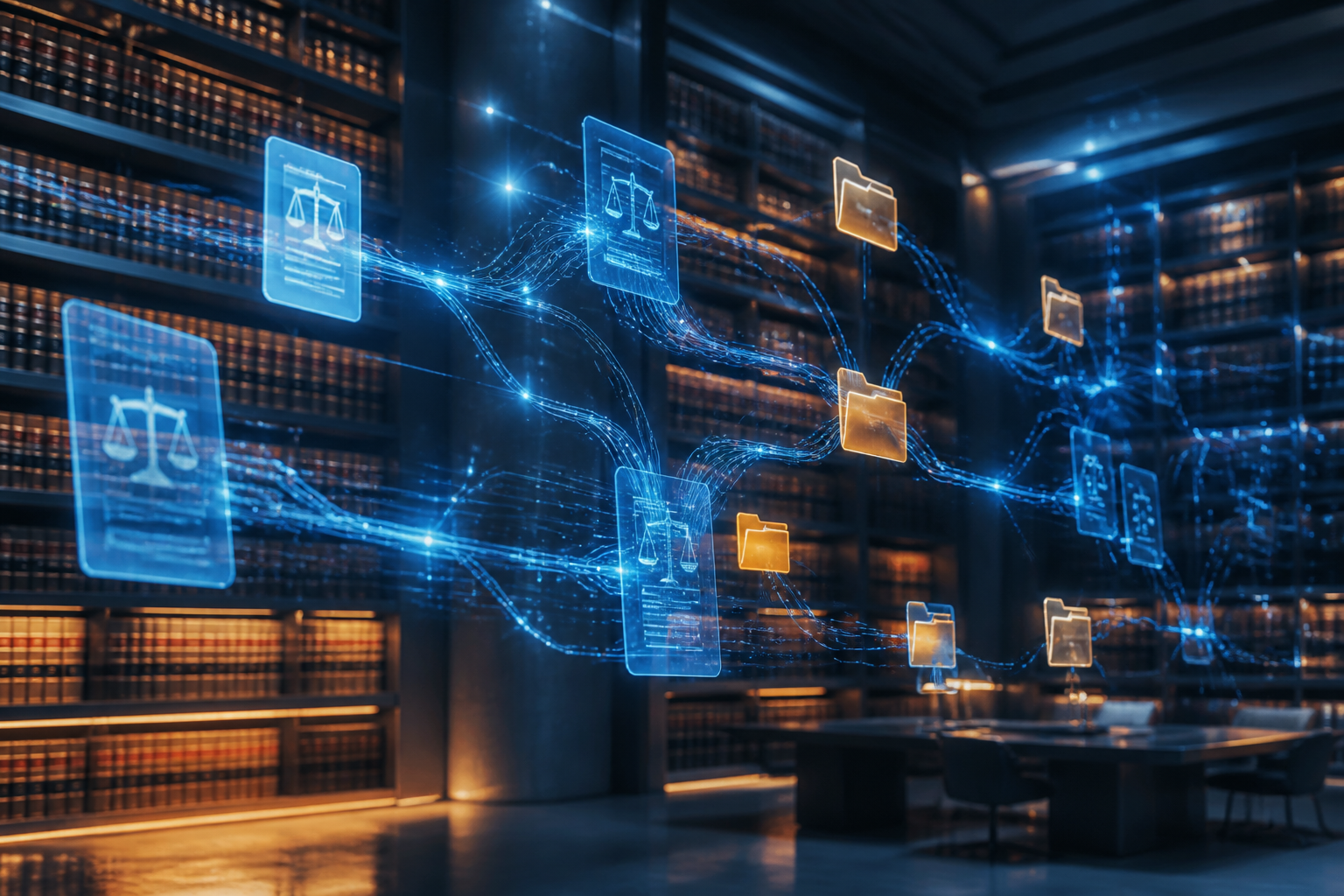
The legal industry is shifting from static Predictive Coding to autonomous AI agents capable of recursive reasoning. These agents don't just tag documents; they construct narratives and identify smoking guns with minimal human intervention.
The Shift from Passive Tools to Active Legal Intelligence
As of August 2026, the electronic discovery (e-discovery) landscape has undergone a fundamental transformation. For over a decade, the gold standard for large-scale document review was Technology Assisted Review (TAR) 1.0 and 2.0—systems that relied on simple supervised learning to extrapolate human coding decisions across millions of files. Today, that paradigm is being dismantled by the widespread deployment of autonomous AI agents. Unlike their predecessors, these agents possess recursive reasoning capabilities, allowing them to navigate complex data repositories, understand nuanced privilege claims, and perform cross-document analysis without the constant 'seed set' training required by older predictive coding models.
The catalysts for this shift are advanced Agentic Workflows powered by models like GPT-5 and Anthropic’s Claude 4. These systems are no longer merely reactive. Companies such as Relativity and KLDiscovery have integrated 'Reasoning Engines' that act as first-pass associates. They do not just identify keyword relevance; they evaluate the 'intent' behind communications. This leap in capability is addressing the astronomical data volumes generated by modern corporate communication stacks—from Slack and Microsoft Teams to ephemeral messaging apps—which have rendered traditional linear review and even basic TAR 2.0 insufficient for the demands of 2026 litigation.
The Demise of the Seed Set and the Rise of Zero-Shot Agents
In the previous era of legal tech, counsel spent weeks refining a 'seed set' of documents to train a machine-learning algorithm. This process was prone to human bias and often required costly re-calibration. The new generation of autonomous agents utilizes 'zero-shot' or 'few-shot' prompting architectures. By ingesting the legal theory of a case—such as a specific complaint or a set of interrogatories—the agent can immediately begin identifying key evidence with a precision that often exceeds junior human reviewers.
Furthermore, these agents are now capable of 'multimodal discovery.' They can simultaneously process audio recordings of corporate meetings, video calls, and spreadsheet metadata to find discrepancies. For instance, in the recent In re: Global Logistics Antitrust Litigation (2026), the defense successfully used an autonomous agent to scan 40 terabytes of data, identifying a critical 'smoking gun' audio clip nested within a seemingly unrelated calendar invitation—a task that would have taken human reviewers thousands of hours to uncover, if they found it at all.
Key Differences: TAR vs. Agentic Discovery
- TAR requires manual training; Agents utilize recursive reasoning and legal instructions.
- TAR identifies keywords and patterns; Agents identify narrative inconsistencies and subtext.
- TAR is limited to text; Agents handle video, audio, and complex structured data.
- Agents provide automated 'Reasoning Memos' explaining why a document was tagged as relevant.
Judicial Acceptance and the Standard of Reasonable Inquiry
The adoption of autonomous agents has not been without controversy in the courts. Federal Rule of Civil Procedure 26(g) requires an attorney's signature to certify that a disclosure is complete and correct. The question for 2026 is whether a lawyer can ethically certify the results of an autonomous agent. A landmark ruling earlier this year from the Southern District of New York suggested that the standard of 'reasonable inquiry' is satisfied not by reviewing every document, but by verifying the agent’s logic and auditing its 'thought process' logs.
We are moving away from the 'black box' of early AI. Modern legal agents provide a transparent audit trail of their reasoning. The lawyer's role is shifting from a manual laborer of data to a supervisor of sophisticated digital systems. The duty of competence now mandates an understanding of these agentic workflows.
Judges are increasingly demanding 'AI Disclosure Statements' in Rule 26(f) conferences. These statements require parties to outline the prompts, constraints, and validation methods used for their autonomous agents. This transparency is critical for ensuring that the use of high-speed AI does not trample on the principles of proportionality and fairness that underpin the adversarial system.
Operational Challenges: Hallucinations and Privilege Leaks
Despite their efficiency, autonomous agents introduce new risks. The primary concern is 'agentic drift,' where a system, in its attempt to be helpful, might broaden the scope of discovery beyond what was intended, leading to the accidental production of privileged material. To combat this, modern e-discovery platforms have implemented 'privilege firewalls'—secondary, disconnected AI agents whose sole purpose is to act as a fail-safe, scanning outgoing productions for attorney-client communication patterns that the primary agent might have missed.
Data security also remains a paramount concern. In 2026, the trend has moved toward 'On-Premise LLMs' or private cloud instances. Law firms are no longer comfortable sending sensitive client data to public API endpoints. Instead, they are deploying containerized versions of models like Meta’s Llama 4 or custom-tuned legal models within their own secure environments to ensure that the AI's learning stays within the firm’s walls and does not leak into the broader public model training sets.
The Future: Real-Time Discovery and Live Monitoring
Looking toward the end of the decade, the concept of 'discovery' itself may shift from a retrospective event to a proactive, real-time function. Large corporations are beginning to deploy 'Compliance Agents' that monitor internal data streams in real-time, flagging potential antitrust or regulatory violations before a subpoena is ever issued. This 'Always-On Discovery' represents the ultimate evolution of legal AI, where the distinction between data management and litigation readiness completely disappears.
For law firms, this means a shift in billing models. The traditional hourly rate for document review is dead. In its place, firms are charging for 'Model Orchestration' and 'Strategic Oversight.' The value is no longer in the eyes on the page, but in the quality of the instructions given to the agent and the ability to interpret the high-level insights the AI generates. As we navigate the remainder of 2026, the firms that master these autonomous agents will be the ones that define the next century of legal practice.
Key Takeaways
- →Autonomous agents are replacing traditional TAR by using recursive reasoning instead of static seed sets.
- →Judges are redefining 'reasonable inquiry' to include the supervision of agentic reasoning logs.
- →Multimodal discovery is now standard, with agents analyzing audio, video, and text simultaneously.
- →Private, on-premise LLMs have become the industry standard for maintaining privilege and data security.
- →The role of junior associates is pivoting from document review to AI orchestration and prompt engineering.
Frequently Asked Questions
What is the difference between TAR 2.0 and an autonomous AI agent?+
TAR 2.0 uses statistical patterns to identify similar documents based on human-coded samples. Autonomous AI agents, however, use Large Language Models to understand the context and meaning of documents, allowing them to follow complex instructions and perform reasoning tasks like summarizing why a document is relevant.
How do courts view the use of autonomous agents in 2026?+
Courts generally accept their use provided there is transparency. Under updated local rules in many jurisdictions, parties must disclose their AI workflows and provide validation reports (such as elusion tests) to prove the agent's effectiveness and the lawyer's supervision.
Can AI agents be trusted with attorney-client privilege?+
While highly effective, they are not perfect. Law firms typically use a 'layered' approach, where one agent performs the initial review and a separate, specialized 'Privilege Agent' provides a final check to prevent accidental disclosure of sensitive communications.
Will autonomous agents eliminate the need for human document reviewers?+
It significantly reduces the number of human reviewers needed, but it does not eliminate the need for human oversight. Humans are still required to handle high-level strategy, resolve complex privilege disputes, and defend the discovery process in court.
Continue reading
Found this useful?
Share it with your network.
Stay ahead of legal AI
Get our weekly briefing on AI for legal & contracts — read by 12,000+ general counsel and legal ops leaders.
Subscribe to the briefing